
PN1-S25 Profinet Gateway Module

The Ebyte PN1-S25 is a gateway module designed specifically for industrial communication. Its core function is to seamlessly map Modbus RTU protocol data to the Profinet network. The product’s technological highlights lie in its intelligent protocol conversion capabilities and ultra-compact industrial design. Measuring only 24.0 × 19.0 × 3.2 mm, it features a built-in shielding cover, strong anti-interference capabilities, and weighs only 3 ± 1 g, making it one of the smallest Profinet gateway modules currently on the market.
The product adopts a 3.3V power supply design, with typical operating currents of 93mA (standby) and 125mA (peak), achieving a balance between low power consumption and high performance.
The PN1-S25’s technological advantage lies in its ability to automatically identify and convert the mapping relationship between Modbus register data and Profinet I/O areas.
The core of this intelligent conversion technology is its memory mapping mechanism. The system can intuitively establish the correspondence between Modbus register addresses and Profinet input/output areas. Engineers only need to look up the memory mapping table in STEP 7 or TIA Portal software to quickly complete data configuration. This design greatly simplifies system integration complexity and improves engineering implementation efficiency.
Real-time protocol conversion is also a significant technological advantage of this product. Supporting communication cycles of up to 4ms, it can meet the real-time requirements of most industrial control applications. Whether for high-speed data acquisition or real-time process control, the PN1-S25 provides stable and reliable data transmission.
In the traditional integration process of industrial communication equipment, programming is often an unavoidable step. Engineers previously needed in-depth knowledge of protocol details and to write complex communication programs, which not only increased project development timelines but also raised the technical barrier to entry. The PN1-S25 addresses this issue through GSD file integration technology.
The GSD (General Station Description) file is the standard description file for Profinet devices. The PN1-S25 provides a complete GSD file, supporting standard Profinet device discovery and configuration processes. Users simply import the GSD file into their PLC programming software, and the system automatically identifies the device and completes basic configuration.

The PN1-S25 incorporates comprehensive device status monitoring capabilities, enabling real-time detection and feedback of Modbus device connection status.
The system provides device connection information via dedicated status bytes, including key parameters such as device online status, communication quality, and error codes. This information is transmitted to the PLC system in real time, providing comprehensive device operation status monitoring capabilities.
The PN1-S25 employs a 3.3V±0.2V power supply design. This voltage selection ensures both low power consumption and sufficient drive capability. Typical operating currents are 93mA (standby) and 125mA (peak), a power consumption level that is excellent among similar products.
The 3.3V communication level design allows the product to interface directly with most modern microcontrollers and processors without the need for additional level conversion circuitry. This design simplifies system integration complexity and improves the overall cost-effectiveness of the solution.
For network communication, the PN1-S25 supports the standard Profinet protocol (RT), with communication cycles of 1~4ms, meeting the real-time requirements of most industrial control applications. The communication bandwidth supports 10/100M adaptive speed, automatically adjusting the communication speed according to network conditions.
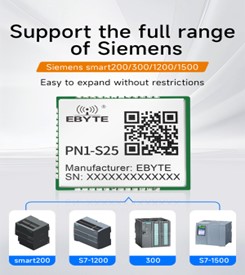
Full support for the Profinet protocol allows for seamless integration into Profinet-based automation systems. Whether it’s a Siemens S7 series PLC or other Profinet-compatible controllers, the product can be directly recognized and configured.
Serial communication is a crucial interface for the PN1-S25 to communicate with traditional Modbus devices. The product supports the standard Modbus RTU protocol, with baud rates ranging from 1200bps to 3.9Mbps, covering all commonly used communication speed requirements.
The stamp-hole serial interface design not only ensures reliable electrical connections but also supports miniaturized product design. This interface type is particularly suitable for direct soldering on circuit boards or connection using connectors, reducing system footprint.

The PN1-S25 meets industrial-grade standards in terms of electrical characteristics, environmental adaptability, and mechanical structure.
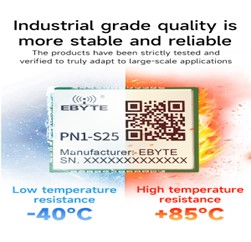
Regarding electrical reliability, it features a built-in shielding cover for strong anti-interference capabilities. The product is designed with a wide temperature range, operating from -40℃ to +85℃, and a storage temperature range reaching -105℃. This temperature range design allows the product to adapt to various climatic conditions from polar to tropical regions. Its humidity adaptability range is 5%-95%RH (non-condensing), ensuring reliable operation in humid environments.
The value of the PN1-S25 is mainly reflected in the following aspects:
1. Reduced system integration costs: No-code integration significantly reduces project development workload, shortens project cycles, and lowers labor costs.
2. Improved system reliability: Industrial-grade design ensures stable operation of the product in harsh environments, reducing system failures and maintenance costs.
3. Enhanced system flexibility: Modular design allows the system to be flexibly configured and expanded according to actual needs.
4. Simplified maintenance: Status monitoring functions provide important support for equipment maintenance, improving maintenance efficiency.
As an important product in the field of industrial communication, the PN1-S25 ProfiNet to Modbus RTU gateway module is undoubtedly a reliable choice for users seeking high-quality, high-reliability, and cost-effective protocol conversion solutions.